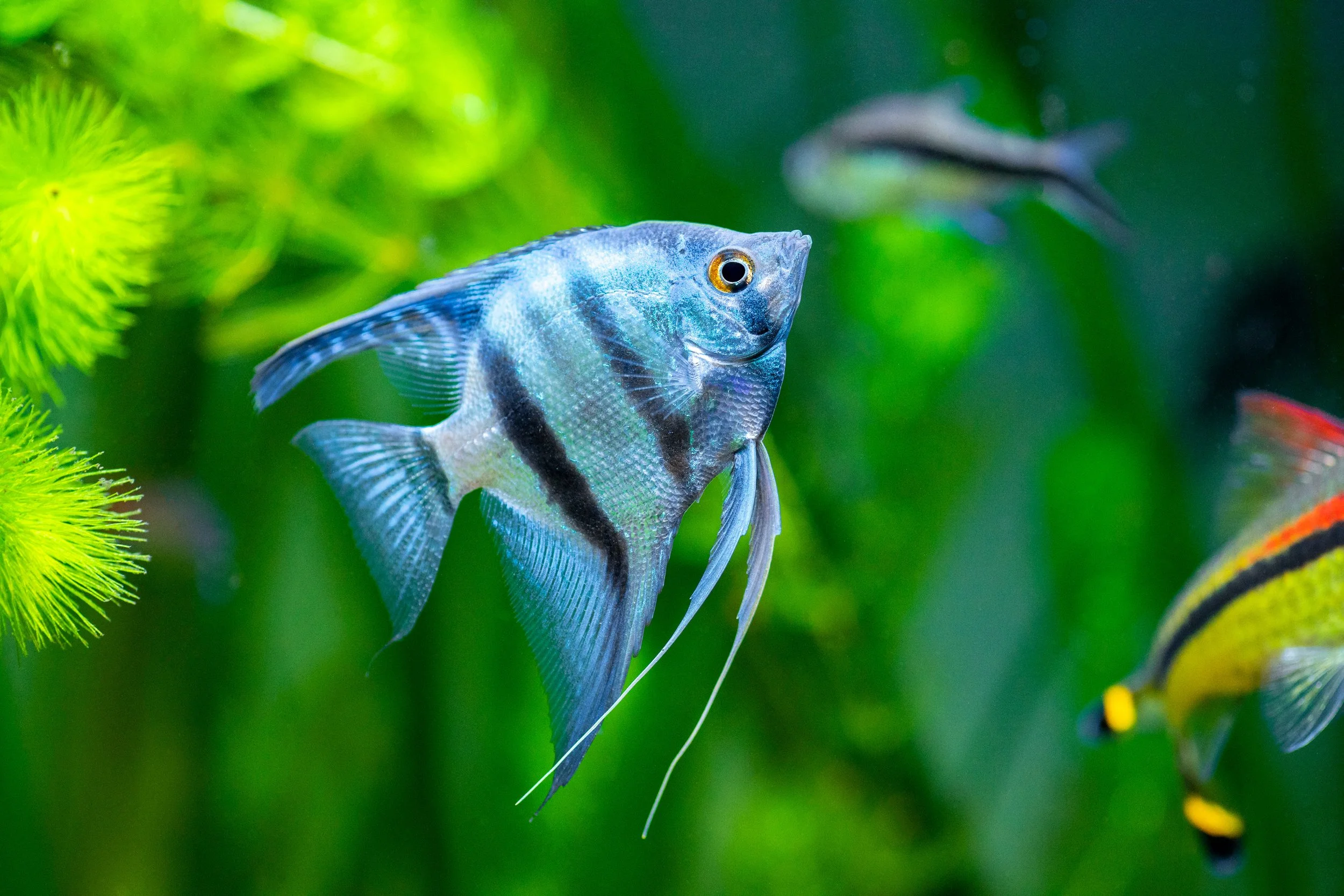
Angelfish
Common Name
Angelfish
Scientific Name
Pterophyllum scalare
Pterophyllum scalare
Adult Size:
6 inches (15 cm) body, up to 10 inches (25 cm) tall
Recommended Group Size:
1–5 with caution
Experience Level:
Intermediate
Recommended Aquarium Size
Angelfish require spacious, tall aquaria to support their unique vertical body and fin height. For a bonded pair, a 29-gallon tall tank is the recommended starting point, but groups of four to five, which allow for natural pecking order and pairing, do best in a 55-gallon or larger aquarium to minimize territorial disputes and stress
| Number of Fish | Minimum Tank Size | Notes |
|---|---|---|
| Single/Bonded Pair | 20 gallons (standard height) | Height is important due to their vertical body shape |
| Pair | 29 gallons (tall) | For breeding or forming a pair |
| Group (4–5 fish) | 55 gallons or larger | Reduces stress and aggression; essential for harmony |
Compatible Tank Mates
Angelfish can do well with a range of peaceful mid-sized tank mates that tolerate similar warm water conditions. Very small fish, like neon tetras or young guppies, may be eaten by mature angels, while very aggressive, large, or nippy fish (like barbs or other cichlids) will stress or injure them
| Compatible Species | |
| Compatible Species | Notes |
|---|---|
| Corydoras catfish | Peaceful bottom dwellers, help clean leftover food |
| Larger tetras | Black Skirt, Rummy Nose, Bleeding Heart; avoid small tetras |
| Bristlenose pleco | Algae eater, peaceful |
| Gouramis (Pearl, Moonlight) | Large, peaceful types only; avoid dwarf gouramis |
| Livebearers (platies, mollies) | Often compatible, avoid tiny fry with adults |
| Dwarf cichlids (e.g. rams) | If tank is large and well-structured |
| Incompatible Species | |
| Incompatible Species | Reason |
| Tiger barbs, serpae tetras | Fin nippers, will attack angelfish’s long fins |
| Neon tetras, guppies | Risk of being eaten when adult angels mature |
| Oscars, jack dempsey, large cichlids | Aggressive species, likely to harm angels |
| Small shrimps | Will be eaten |
Water Parameters
Consistency in water quality is more important than achieving an exact number within these ranges. Regular water changes (at least 25% weekly) and strong filtration are critical, as angelfish are intolerant of heightened ammonia and nitrite
| Parameter | Ideal Range | Notes |
|---|---|---|
| Temperature | 76–82°F (24–28°C) | Stable, avoid sudden swings |
| pH | 6.5–7.5 (tolerates 6.0–8.0) | Neutral to slightly acidic preferred |
| Hardness (dGH) | 3–15 dGH | Softer water preferred, captive-breds are adaptable |
| Ammonia/Nitrite | 0 ppm | Highly sensitive to poor water quality |
| Nitrate | <20 ppm | Keep low with regular water changes |
History and Origin
Native to the Amazon River basin and adjacent South American river systems, angelfish inhabit slow-moving, heavily vegetated backwaters. Their striking appearance, elongated fins, and diamond-shaped bodies allow for camouflage among submerged roots and plants, offering natural defense from predators. Pterophyllum scalare is the most widely bred and traded; related species include P. altum and P. leopoldi, though these are rarer in the hobby. Captive-bred strains now display a huge range of color morphs and fin types
Temperament and Personality
Angelfish are intelligent cichlids with a semi-aggressive temperament. They are intensely territorial, especially during breeding, and may chase similar-bodied or long-finned tank mates. With conspecifics, they establish dominance hierarchies, which emphasizes the importance of ample space and visual barriers such as tall plants or decorations. In a properly managed community tank, they display curious and sometimes interactive behaviors, often recognizing their caregivers.
During breeding, they guard their eggs and fry fiercely, demonstrating exceptionally developed parental care for aquarium fish. Outside the breeding season, angelfish can be relatively peaceful, but bullying can arise if there is crowding, improper group sizes, or mismatched tank mates
Other Pertinent Information
Diet: Omnivorous. Feed high-quality flake, slow-sinking pellets, and supplement with frozen/live foods (bloodworms, brine shrimp, daphnia) and small amounts of blanched vegetables.
Tank Setup: Tall aquarium with fine sand or smooth gravel; aquascaped with vertical driftwood, broad-leaved plants (e.g., Amazon sword, Vallisneria), and some floating plants to diffuse light.
Health Concerns: Prone to Ich, fin rot, and stress-related aggression if water conditions deteriorate.
Behavioral Management: Provide hiding spots, break sightlines with hardscape, and avoid overcrowding. Remove breeding pairs if aggression escalates.
Reproduction: Bonded pairs clean a spawning surface and deposit eggs, which both parents fan and guard. Fry initially feed off parent-secreted mucus; breeding is best attempted in a separate setup.
Lifespan: 8–12 years with optimal conditions.