Guppy
Common Name
Guppy (Millionfish, Rainbowfish)
Scientific Name
Poecilia reticulata
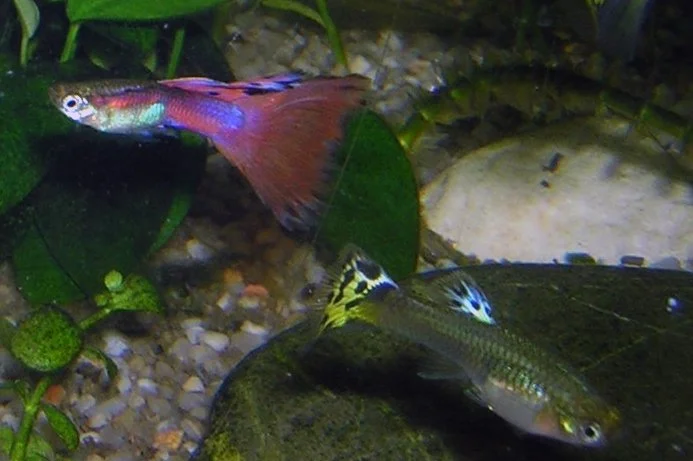
Poecilia reticulata
By Federico Cisnetti - Own work, CC BY-SA 3.0, https://commons.wikimedia.org/w/index.php?curid=1464719
Adult Size
Males: 1.2–1.6 inches (3–4 cm) Females: 2–2.4 inches (5–6 cm)
Recommended Group Size:
6+
Experience Level:
Beginner
Recommended Aquarium Size
More space is always beneficial, as guppies breed rapidly. For more than a trio, or for community set-ups, provide 10+ gallons. Overcrowding magnifies aggression and waste buildup
| Group Size | Minimum Tank Size |
|---|---|
| Trio (1M:2F) | 5 gallons |
| Small group | 10 gallons |
| Community/breeding | 20–30 gallons+ |
Compatible Tank Mates
Guppies are best with other small, peaceful fish and invertebrates. Avoid aggressive or territorial tank mates that will bully or outcompete them for food
| Compatible Species | Notes |
|---|---|
| Corydoras catfish, otocinclus | Peaceful, bottom dwellers |
| Other livebearers (platies, mollies, endlers) | Provide similar water conditions; avoid hybridization risks |
| Small peaceful tetras (neon, ember, cardinal) | Only adult tetras; juveniles may be eaten by guppies |
| Rummy nose tetras, danios, rasboras | Peaceful, compatible with proper schooling |
| Amano/mystery snails, cherry shrimp | Adults generally safe, but young shrimp/fry may be at risk |
| Avoid large, predatory, or fin-nipping species | Cichlids, tiger barbs, bettas, paradise fish, goldfish |
Guppies thrive in peaceful, well-balanced community tanks with species that match their temperament, size, and water preferences. They are social, active livebearers that do best with other small, non-aggressive fish and invertebrates.
Bottom dwellers like Corydoras catfish and Otocinclus are excellent companions, as they occupy different zones of the tank and help clean up uneaten food. Their peaceful nature and small size make them ideal for guppy setups.
Other livebearers such as platies, mollies, and endlers share similar water parameters and feeding habits. However, avoid mixing guppies with endlers if you want to prevent hybridization, especially in breeding-focused tanks.
Small tetras like neon, ember, and cardinal can coexist with guppies, but only as adults. Juvenile tetras may be mistaken for food due to guppies’ opportunistic feeding behavior. Always monitor for nipping or chasing during acclimation.
Schooling fish like rummy nose tetras, danios, and rasboras are generally compatible, provided they are kept in proper group sizes. Their fast swimming and peaceful nature help balance guppy energy and reduce stress.
Invertebrates such as Amano and mystery snails, and adult cherry shrimp can be safe additions, especially in planted tanks. However, guppies may harass or eat young shrimp and fry, so hiding spaces and population control are essential.
Avoid housing guppies with large, predatory, or fin-nipping species like cichlids, tiger barbs, bettas, paradise fish, or goldfish. These species may bully, injure, or consume guppies, especially in confined or poorly aquascaped tanks.
In short, guppies do best in calm, well-structured environments with similarly sized, peaceful companions. Prioritize water quality, group dynamics, and behavioral compatibility to ensure long-term health and harmony.
Water Parameters
Guppies are hardy but do best in measured, mineral-rich, slightly alkaline water. Soft, acidic water is not conducive to health or breeding. Weekly 25–30% water changes are essential for long-term health
| Parameter | Ideal Range |
|---|---|
| Temperature | 72–82°F (22–28°C) Optimum: 76–78°F |
| pH | 7.0–8.0 |
| Hardness | 8–12 dGH |
| KH (buffering) | 4–8 dKH |
| Ammonia/Nitrite | 0 ppm |
| Nitrate | <20 ppm (ideally <10 ppm) |
History and Origin
Guppies originate from northeast South America (including Venezuela, Brazil, Trinidad, and Barbados), where they inhabit slow, vegetated streams and ponds. Famous as “millionfish” for their fertility, they have been introduced worldwide for mosquito control and occasionally become invasive. Extensive selective breeding has produced dozens of color morphs and spectacular tail shapes (fan, sword, lyretail) seen in the hobby today
Temperament and Personality
Guppies are peaceful, playful, and active—especially males, which court females by displaying their colors and pursuit behavior. They are social and require the company of their own kind. Too many males can stress females; maintain a 1:2 (or greater) female-to-male ratio to prevent harassment. If males outnumber females, stress and reduced lifespan are likely. Guppies are surface and mid-level swimmers and are rarely shy; they may nip at fins if crowded or in unbalanced groups
Other Pertinent Information
Diet: Omnivorous; high-quality flakes/pellets, plus routine supplement of live/frozen foods (brine shrimp, daphnia, bloodworms), and vegetable matter (zucchini, spirulina, peas)
Tank Setup: Fine gravel or sand, dense planting with Java moss, guppy grass, floating plants; gentle filtration (sponge filters ideal)
Reproduction: Livebearers; females give birth to 20–100 fry every 21–35 days. Fry need hiding spaces to avoid cannibalism.
Breeding setup: 10-gallon tank with dense plants, 78–80°F, and a sponge filter
Health: Prone to fin rot, ich, velvet, and “guppy disease”; avoid rapid water parameter swings
Behavioral notes: Overbreeding and population explosions are common; manage with single-sex tanks or by culling
Lifespan: Typically 2–3 years, can be extended with optimal genetics and care.