Firefish
Common Name
Firefish, Fire Goby, Fire Dartfish
Scientific Name
Nemateleotris magnifica
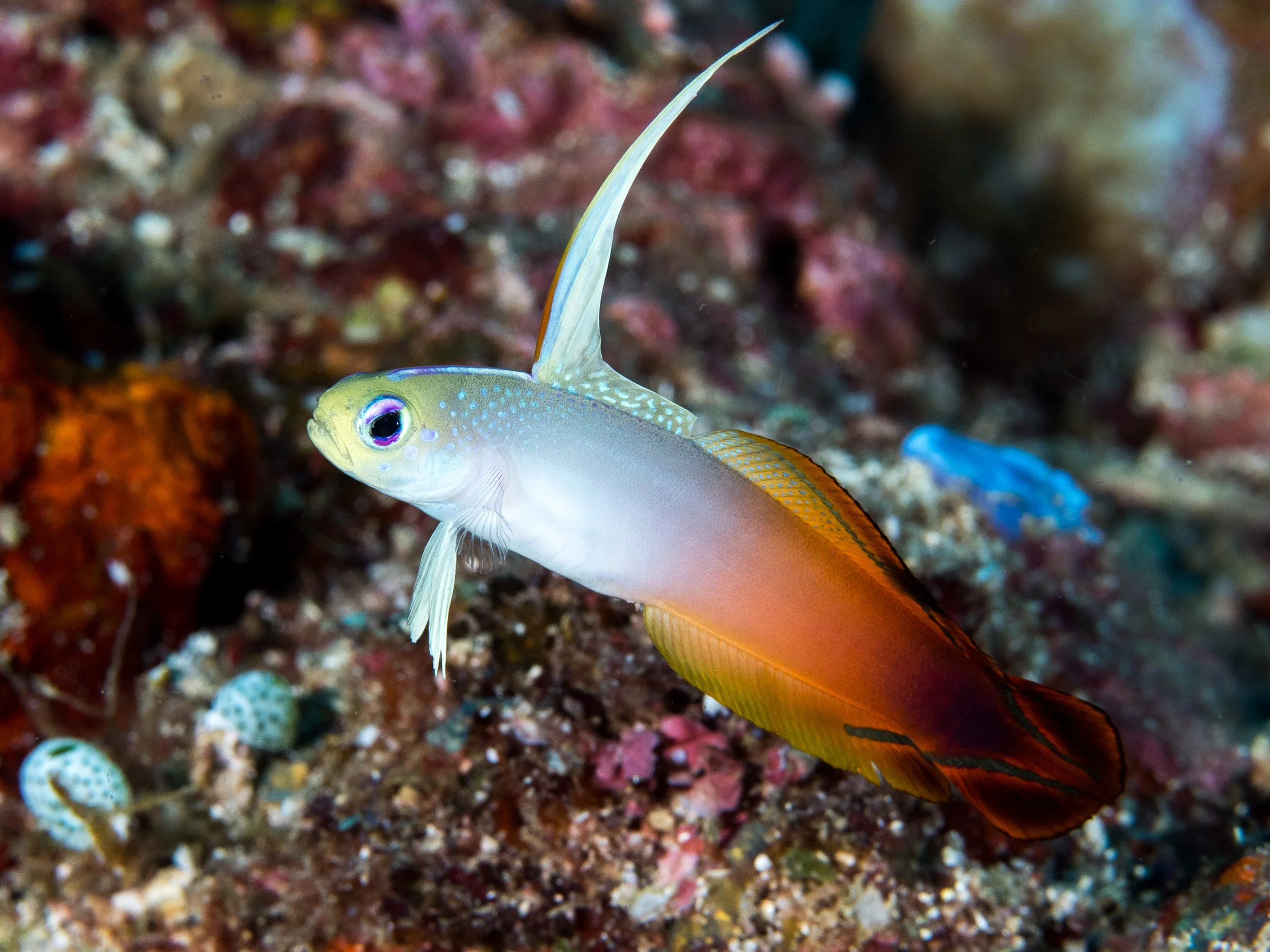
Firefish (Nemateleotris magnifica) possess a specialized swim bladder that allows them to hover motionlessly in the water column — a trait that helps them conserve energy while staying alert for predators. Fun Fact: When startled, Firefish can vanish into rock crevices in the blink of an eye — but they’ll often return to the exact same perch once they feel safe again, like clockwork!
Rickard Zerpe, CC BY 2.0 <https://creativecommons.org/licenses/by/2.0>, via Wikimedia Commons
Adult Size
2.5–3.5 inches (6–9 cm)
Description
Slender, rocket-shaped, and neon-colored, the Firefish (Nemateleotris magnifica) is a peaceful reef dweller that adds motion and vibrancy to the midwater column of nano and small reef tanks. Its body glows with a gradient of white to orange, accented by a long, sail-like dorsal fin and expressive eyes that give it a curious, alert appearance.
Firefish are known for their hovering posture and sudden darting movements — behaviors that mimic their natural reef environment, where they retreat into narrow crevices when startled. Despite their shyness, they become confident and visible once settled, often perching near their chosen retreat and darting out for food.
This species is ideal for beginner reefkeepers due to its hardy nature, peaceful temperament, and small size. It thrives in tanks with stable water quality, moderate flow, and thoughtful aquascaping that includes narrow caves and overhangs. A tight-fitting lid is essential, as Firefish are notorious jumpers when startled or stressed.
Recommended Aquarium Size & Water Parameters
Firefish are well-suited to nano and small reef aquaria, with a recommended minimum tank size of 20–30 gallons. They require stable tropical conditions and benefit from moderate flow that mimics reef slopes. Consistent water quality is key to reducing stress and preventing jump-related loss.
| Parameter | Range & Notes |
|---|---|
| Minimum Tank Size | 20–30 gallons; suitable for single Firefish or bonded pair |
| Temperature | 75–82°F (24–28°C); stable tropical range preferred |
| Specific Gravity | 1.023–1.026; reef-safe salinity range |
| pH | 8.1–8.4; slightly basic, supports biological stability |
| Nitrate | <20 ppm (fish-only); <5–10 ppm (reef); lower levels preferred for coral health |
Reef Safety & Compatibility
Firefish are reef-safe and peaceful, making them ideal for mixed reef tanks and nano setups. They coexist well with other small, non-aggressive species and are unlikely to harass corals or invertebrates. However, they are sensitive to bullying and may refuse to eat or jump from the tank if stressed.
| Category | Examples | Notes |
|---|---|---|
| Ideal | Clownfish, Gobies, Royal Gramma, small Wrasses | Peaceful tankmates that won’t outcompete for hole/cave space |
| Caution | Large aggressive fish, big dottybacks | May bully or chase; Firefish are jumpers — use covered tank |
| Avoid | Large predatory wrasses, large angels | Predation risk or consistent harassment |
| Tank Layout Tip | Rockwork with narrow caves and overhangs | Provide secure perches and a tight-fitting lid to prevent jumping |
History & Origin
The Firefish is native to the Indo-Pacific, where it inhabits reef slopes and sandy bottoms near coral outcroppings. Its popularity in the aquarium trade stems from its peaceful nature, compact size, and stunning coloration — making it a staple in nano reef systems.
Captive breeding is rare but possible, especially when bonded pairs are provided with optimal nutrition and stable conditions.
Temperament & Personality
Firefish are shy but curious, often forming pair bonds in larger tanks. They hover gracefully near their retreat and dart quickly when startled. Their peaceful nature makes them ideal for community tanks, but they require secure hiding spots and a covered aquarium to prevent jumping.
Care Highlights
Diet: Carnivore/omnivore — daily feedings of copepods, mysis shrimp, enriched brine shrimp, and micro-pellets. A varied, protein-rich diet supports coloration and energy levels.
Tank Setup: Rockwork with narrow caves and overhangs; moderate flow and stable water quality. A tight-fitting lid is essential to prevent jumping.
Breeding: Spawning has been reported in captivity when bonded pairs are provided with excellent nutrition and stable conditions.
Health: Hardy but stress-sensitive; avoid aggressive tankmates and sudden changes in water chemistry.
Common Health Issues: Jump-related loss (open-top tanks), stress-induced refusal to eat, and occasional protozoan infections if water quality lapses.
Lifespan: 3–6 years in well-maintained aquaria.