Glass Catfish
Common Name
Glass Catfish, Ghost Catfish, Phantom Catfish
Scientific Name
Kryptopterus vitreolus
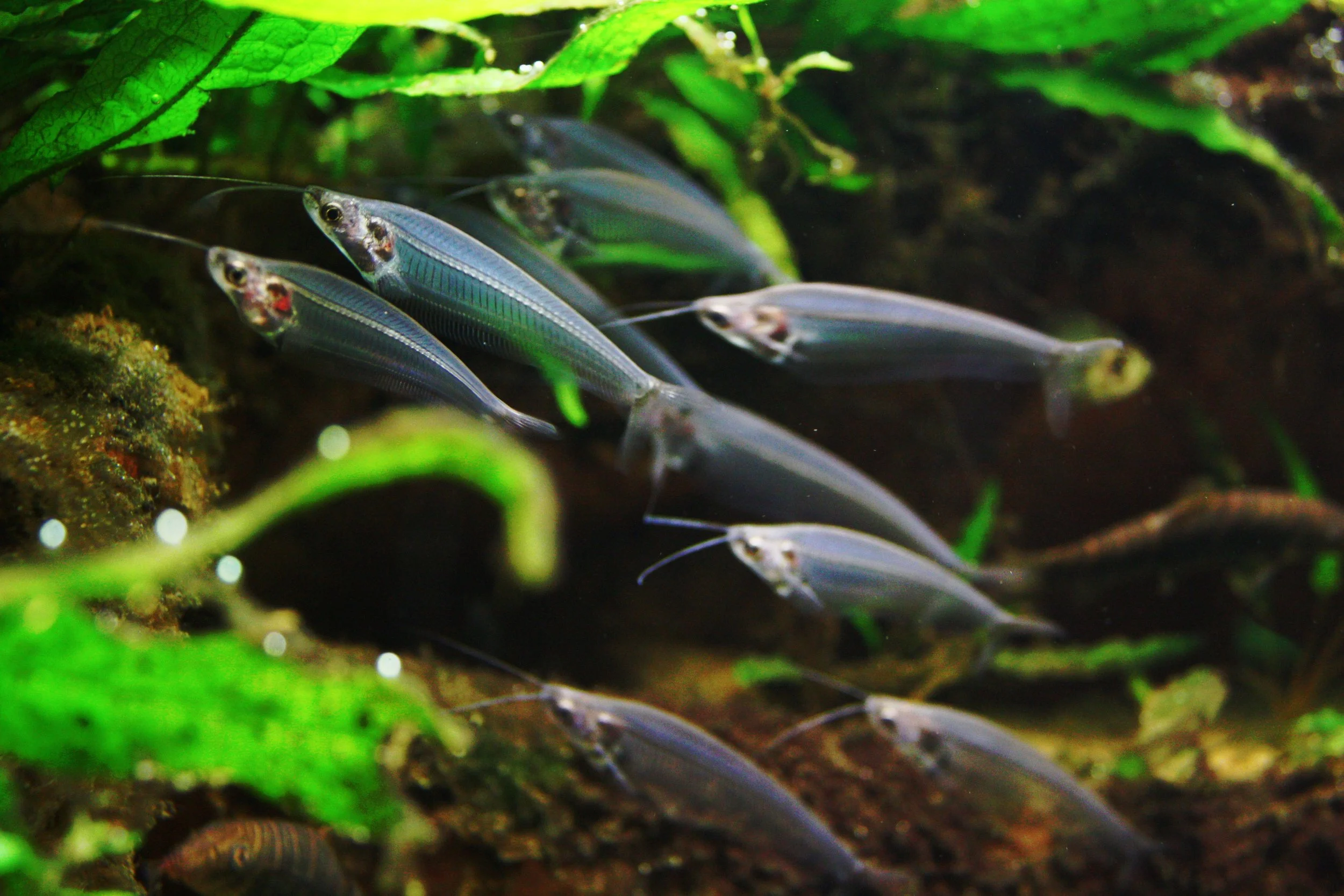
Glass Catfish (Kryptopterus vitreolus) is a peaceful, midwater schooling fish native to Thailand, known for its fully transparent body and gentle demeanor. Reaching 4–6 inches, it thrives in groups of six or more and requires soft lighting, clean water, and calm tank mates to avoid stress. Its ghost-like appearance and synchronized swimming make it a captivating addition to planted aquariums.
Fun fact: You can see its spine and heartbeat through its body—making it one of the few truly transparent vertebrates in the animal kingdom.
By Martin Fisch - originally posted to Flickr as Glaswelse, CC BY-SA 2.0, https://commons.wikimedia.org/w/index.php?curid=8229858
Adult Size:
4–5 inches (10–13 cm)
Recommended Group Size:
6+
Experience Level:
Intermediate
Recommended Aquarium Size and Water Parameters
Minimum Tank Size
A minimum of 30 gallons (120 liters) is recommended to house a group of six or more Glass Catfish. These fish are highly social and require schooling to feel secure—solitary individuals often stop eating and become withdrawn. A longer tank with open midwater space is ideal, allowing them to exhibit their graceful, synchronized swimming behavior.
Temperature
Maintain a stable temperature between 75–80°F (24–27°C). Glass Catfish originate from warm, slow-moving rivers in Thailand and are sensitive to sudden temperature shifts. A reliable heater and gentle water flow help replicate their natural environment.
pH
A pH range of 6.5–7.5 is ideal. Slightly acidic to neutral water mimics their native habitat and supports healthy immune function. Avoid alkaline conditions, which can cause stress and reduce lifespan.
Hardness
Soft to moderately hard water is preferred, with a general hardness (GH) between 8–12 dGH. This range supports osmoregulation and reduces the risk of stress-related illness. Avoid extremes in hardness, especially if using tap water with fluctuating mineral content.
| Parameter | Range |
|---|---|
| Minimum Tank Size | 30 gallons (120 liters), group of 6+ |
| Temperature | 75–80°F (24–27°C) |
| pH | 6.5–7.5 |
| Hardness | 8–12 dGH |
Compatible Tank Mates
Glass Catfish are extremely peaceful and sensitive schooling fish that thrive only when kept in groups of six or more. Their transparent bodies and gentle nature make them vulnerable to bullying, stress, and injury if housed with aggressive or overly active species. Ideal companions include small-to-medium-sized fish that are calm, non-nippy, and occupy different zones of the tank.
Avoid fast-swimming or boisterous species like danios, tiger barbs, or larger cichlids, as these can intimidate or outcompete Glass Catfish during feeding. Also avoid fin-nippers or territorial fish that may harass their trailing barbels or delicate fins.
Tank mates should complement their midwater swimming style and not disrupt their synchronized schooling behavior. Bottom dwellers like Corydoras and peaceful dwarf cichlids (e.g., Apistogramma) are excellent choices, especially in well-planted tanks with shaded areas and gentle flow.
| Species | Compatibility & Notes |
|---|---|
| Harlequin Rasboras | Peaceful, midwater swimmers; excellent visual match and temperament |
| Peaceful Barbs (e.g., Cherry Barbs) | Non-nippy and calm; avoid fast or aggressive barb species |
| Corydoras Catfish | Bottom dwellers; peaceful and unobtrusive |
| Apistogramma | Peaceful dwarf cichlids; compatible in well-aquascaped tanks |
| Otocinclus | Small algae eaters; peaceful and ideal for planted tanks |
| Neon or Cardinal Tetras | Peaceful schooling fish; visually complementary and non-aggressive |
History / Origin
The Glass Catfish (Kryptopterus vitreolus) hails from the slow-moving, shaded rivers and streams of southern Thailand, where dense vegetation and soft substrates create the perfect environment for this delicate, midwater dweller. For decades, aquarists around the world were captivated by its ghostly transparency—so complete that its internal organs and spine are clearly visible through its body. This unique trait earned it a place in the hobby long before science had fully caught up.
For many years, the species was misidentified as Kryptopterus bicirrhis, a larger and more opaque relative. It wasn’t until 2013 that ichthyologists formally recognized Kryptopterus vitreolus as a distinct species, resolving a long-standing taxonomic confusion. This clarification was based on both morphological differences and geographic distribution, as K. bicirrhis is not even found in the aquarium trade.
Today, Kryptopterus vitreolus is celebrated not only for its mesmerizing appearance but also as a symbol of how scientific discovery continues to evolve—even for species that have been part of the aquarium hobby for decades. Its story highlights the importance of accurate classification and the hidden biodiversity still waiting to be uncovered in Southeast Asia’s freshwater ecosystems.
Temperament and Personality
Glass Catfish are exceptionally peaceful and sensitive, thriving only when kept in cohesive groups of six or more. Their gentle nature makes them ideal for calm community tanks, but they are easily stressed by loud environments, sudden movements, or incompatible tank mates. Isolated individuals often become reclusive, hiding constantly and refusing to eat—sometimes leading to fatal stress.
When properly housed and comfortable, they display elegant, synchronized swimming in the midwater zone, often gliding in loose formations that resemble a drifting school of ghosts. Their transparency adds to the visual effect, making their movements feel almost otherworldly. These fish rely heavily on social cues, and their well-being is directly tied to the presence of their own kind.
Other Pertinent Information
Diet: Omnivorous; prefers small live or frozen foods like bloodworms, daphnia, and brine shrimp. Will accept micro pellets and flakes if comfortable.
Tank Setup: Requires open midwater space, dense planting, and floating cover. Gentle flow and subdued lighting reduce stress.
Behavioral Needs: Must be kept in groups of 6 or more to prevent isolation stress and feeding refusal.
Lighting Sensitivity: Prefers dim or filtered light; bright lighting can cause hiding and erratic behavior.
Jump Risk: Known to jump when startled—secure lids are essential.
Transparency Trait: One of the few vertebrates with near-total body transparency; internal organs and spine are visible.
Species Confusion: Often misidentified as Kryptopterus bicirrhis in older literature and trade labels.
Lifespan: Typically 6–8 years with stable conditions and low stress.
Sensitivity: Vulnerable to copper-based medications and poor water quality; avoid sudden changes in parameters.
Activity Zone: Midwater swimmer; rarely interacts with substrate or surface zones.