Pea Puffer
Common Name
Pea Puffer, Dwarf Pufferfish, Malabar Puffer
Scientific Name
Carinotetraodon travancoricus
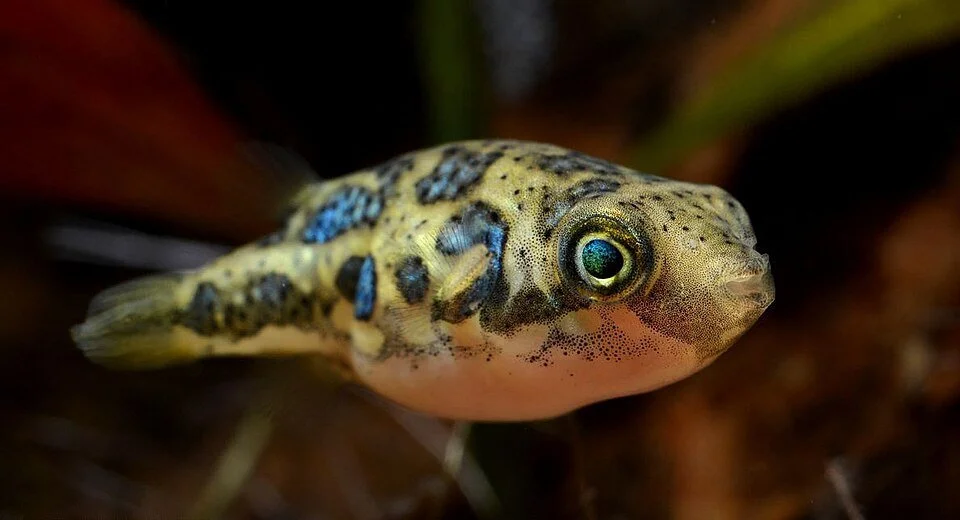
The pea puffer (Carinotetraodon travancoricus) is a tiny, round-bodied freshwater pufferfish with vivid golden-green coloration and bold, expressive eyes. Its compact frame is speckled with dark spots, and its fins are translucent and paddle-like. Despite its small size—just 1 to 1.5 inches—it carries a confident, inquisitive posture, often hovering mid-water or darting through dense plants with surprising agility.
Adult Size:
1 inch (2.5 cm)
Recommended Group Size:
Solo or 3+ with caution
Experience Level:
Intermediate
Recommended Aquarium Size and Water Parameters
| Parameter | Range |
|---|---|
| Minimum Tank Size | 10 gallons (38 liters) solo; 20+ gallons for group |
| Temperature | 74–82°F (23–28°C) |
| pH | 6.5–7.5 |
| Hardness | 5–15 dGH |
Compatible Tank Mates
For species with delicate fins, unique behaviors, or specific water needs, species-only setups are often the safest and most rewarding option. These environments reduce stress, prevent injury, and allow natural behaviors to flourish without interference from incompatible tank mates.
In some cases, fast-moving, similarly sized companions can coexist peacefully—especially if they occupy different zones of the tank or have complementary temperaments. Examples include otocinclus catfish, kuhli loaches, and adult cherry shrimp. These species are agile, non-aggressive, and unlikely to harass or outcompete more sensitive fish.
However, slow-moving or long-finned fish (like bettas or fancy guppies) may provoke unwanted attention or struggle to compete for food. Snails, while common cleanup crew members, are often targeted or nipped at—especially by species with curious or omnivorous feeding habits.
To maintain harmony, prioritize tank mates that:
Match the species in size, speed, and temperament
Thrive in similar water parameters
Don’t compete aggressively for food or territory
| Compatible Species | Notes |
|---|---|
| Species-only setup | Safest option; avoids stress, injury, and competition |
| Otocinclus catfish | Fast, peaceful algae eaters; occupy lower zones |
| Kuhli loaches | Shy, bottom-dwelling scavengers; rarely interact directly |
| Cherry shrimp (adults) | Fast and alert; fry may be at risk |
| Avoid: snails, slow or long-finned fish | May be harassed, nipped, or outcompeted |
Water Parameters
This species thrives in stable, well-maintained water conditions that mimic its natural habitat. While it can tolerate minor fluctuations, long-term health depends on consistency and proper filtration. Regular testing and partial water changes are essential to prevent stress and disease.
Key water parameters include:
Temperature: Maintain within the species’ preferred range to support metabolism and immune function.
pH: Slightly acidic to neutral levels are ideal; sudden shifts can cause stress.
Hardness (dGH): Moderate hardness supports osmoregulation and overall vitality.
Ammonia/Nitrite: Always 0 ppm—these compounds are toxic even in trace amounts.
Nitrate: Keep below 20 ppm through water changes and plant uptake.
For best results, match these parameters to the species’ native environment and tank mates. Use a reliable test kit weekly, and adjust slowly if needed to avoid shock.
Let me know which species this is for and I can tailor the tone or add species-specific notes (e.g., “prefers tannin-rich water” or “tolerates slightly brackish conditions”).
| Parameter | Range |
|---|---|
| Minimum Tank Size | 10 gallons (38 liters) solo; 20+ gallons for group |
| Temperature | 74–82°F (23–28°C) |
| pH | 6.5–7.5 |
| Hardness | 5–15 dGH |
History / Origin
Native to the lush, heavily vegetated rivers and lakes of Kerala and Karnataka in the Western Ghats of southern India, the pea puffer is one of the world's smallest pufferfish. Its population has declined in the wild due to overcollection for the aquarium trade, though captive breeding is now common and helps relieve pressure
Temperament and Personality
Pea puffers are inquisitive, bold, and intelligent. Despite their tiny size, these fish develop distinct personalities and will often learn to recognize and interact with their keepers. They are also known for their territorial tendencies and can be quite aggressive, especially toward conspecifics or slow-moving tank mates. Males display heightened aggression, particularly during breeding.
Other Pertinent Information
Diet: Carnivorous; requires a varied diet of live or frozen foods such as small snails, bloodworms, brine shrimp, and daphnia. Hard-shelled prey is essential to prevent overgrown beaks.
Tank Setup: Dense planting, driftwood, caves, and visual barriers are critical to reduce aggression and mimic natural habitat. A secure lid is recommended—pea puffers are curious and may jump.
Behavioral Needs: Highly intelligent and inquisitive; benefits from enrichment and interaction. Territorial tendencies increase in small tanks or with multiple males.
Breeding: Moderately challenging. Males are more colorful with a dark ventral stripe; females are rounder. Spawning occurs in moss or dense plants. Eggs hatch in 5–7 days; fry require infusoria, then baby brine shrimp.
Health: Extremely sensitive to water quality. Must maintain 0 ppm ammonia and nitrite. Prone to Ich, bacterial infections, and beak overgrowth if diet lacks shelled prey.
Lifespan: Typically 4–5 years with proper care and stable conditions.
Size: Adults reach 1–1.5 inches (2.5–3.8 cm); despite small size, they require spacious, well-maintained environments.