Swordtail
Common Name
Swordtail
Scientific Name
Xiphophorus hellerii
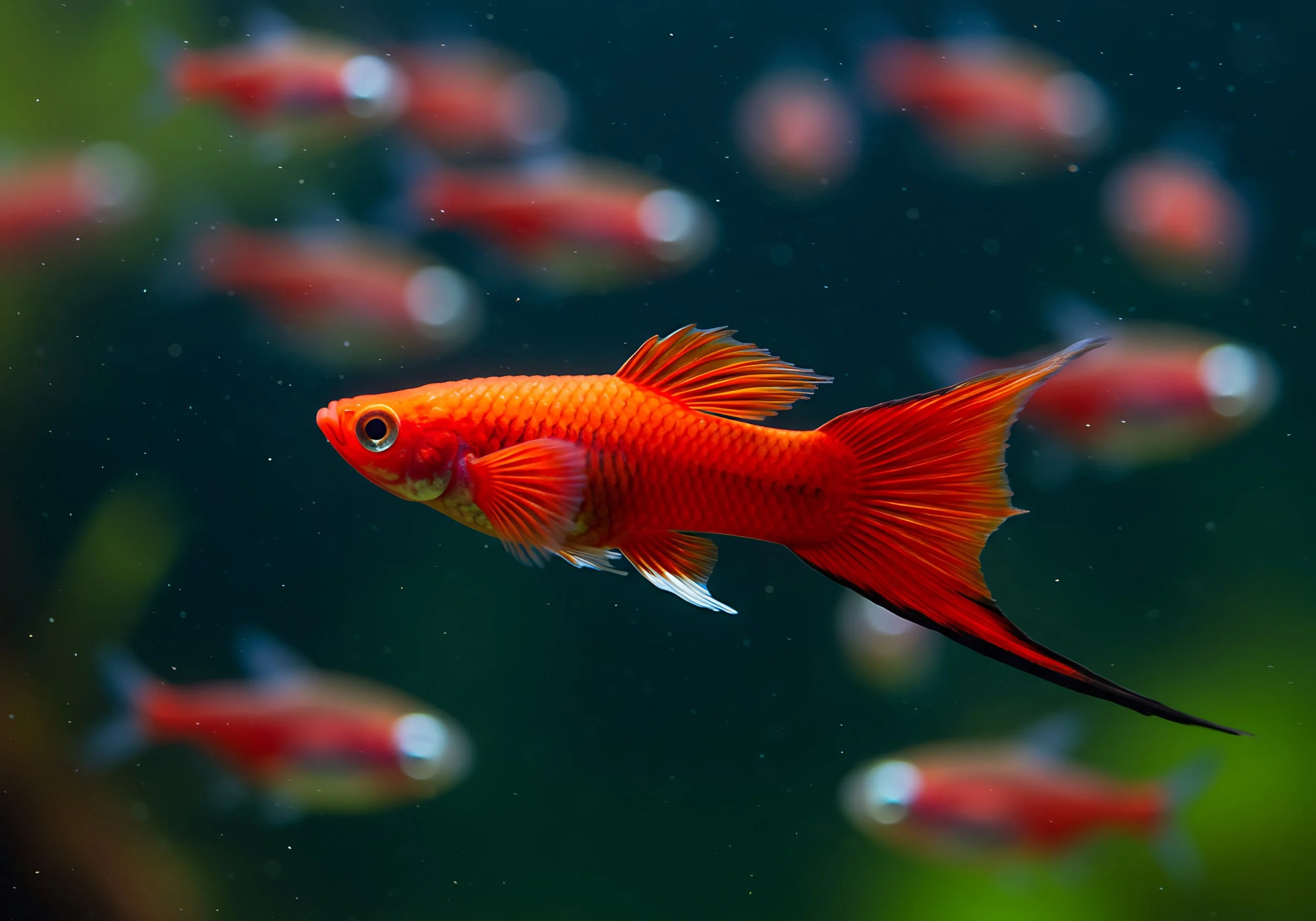
Xiphophorus hellerii, commonly known as the swordtail, is a striking livebearer named for the elongated, sword-like extension on the male’s tail fin. These active, social fish come in vibrant colors like red, green, and orange, and thrive in hard, alkaline water. Fun fact: swordtails can hybridize with platies, creating unique color and fin variations in mixed tanks!
Adult Size
Males: 4.5–6 inches (11–15 cm) including sword Females: ~5 inches (12–13 cm)
Recommended Group Size:
4–6+
Experience Level:
Beginner
Recommended Aquarium Size
Swordtails are larger and more active than guppies or platies, and they require more swimming room. A single swordtail can be housed in 15 gallons, but a group (with multiple females to one male) will do best in 30 gallons or more
| Number of Fish | Minimum Tank Size |
|---|---|
| Single adult | 15 gallons |
| Small group | 30 gallons+ |
Compatible Tank Mates
Swordtails (Xiphophorus hellerii) are hardy, social livebearers that thrive in peaceful community tanks—but their social dynamics require careful attention. While generally friendly, male swordtails can become territorial or competitive, especially in confined spaces or when females are scarce. This behavior may include chasing, fin-nipping, or persistent courting that stresses both females and subordinate males.
To minimize aggression and promote harmony, aim for a female-heavy ratio—ideally four females to every male (4F:1M). This disperses attention, reduces harassment, and allows females to rest between interactions. In mixed-gender groups, provide ample swimming space, visual barriers like plants or décor, and consistent water quality to support natural behavior and reduce stress.
Without proper ratios and space, swordtails may exhibit dominance displays that escalate into fighting or chronic stress, which can weaken immunity and shorten lifespan. A well-balanced group with thoughtful aquascaping helps showcase their vibrant colors, active personalities, and peaceful potential.
| Compatible Species | Notes |
|---|---|
| Platies, mollies, guppies (other livebearers) | Ideal partners, similar needs |
| Corydoras, otocinclus, bristlenose pleco | Bottom dwellers, robust, peaceful |
| Large tetras, danios, rasboras, rainbowfish | Active, non-nippy schooling fish |
| Dwarf gouramis, honey gouramis, peaceful barbs | Only very peaceful strains |
| Avoid: bettas, goldfish, large/territorial cichlids, aggressive barbs | May attack or stress swordtails |
Water Parameters
Swordtails thrive in hard, alkaline water, similar to their livebearer cousins. These conditions support their robust immune system and strong growth
| Parameter | Recommended Range |
|---|---|
| Temperature | 72–82°F (22–28°C) |
| pH | 7.0–8.4 |
| Hardness | 12–35 dGH |
| Ammonia/Nitrite | 0 ppm |
| Nitrate | <20 ppm |
History and Origin
Native to Central America (Belize, Guatemala, Mexico, Honduras), swordtails are found in warm, densely vegetated streams and rivers. Their trademark feature is the extended "sword" tail of the male, which is used for display and mating rituals but serves no combative purpose. Crossbreeding with platies has led to many hybrid strains and color varieties now prevalent in the hobby
Temperament and Personality
Swordtails are active, peaceful, and sociable, though males can become territorial if too many are present or if the tank is cramped. While not true schooling fish, swordtails are happiest in groups. They occupy primarily the middle and upper levels of the tank and benefit from sheltering plants and open space. Males display to females with their swords, and a single dominant male may harass subordinate rivals—adequate tank size and multiple females mitigate this behavior
Other Pertinent Information
Diet: Omnivorous; thrive on flakes, micro-pellets, sinking wafers, variety of greens (spirulina, blanched spinach), and intermittent animal protein (bloodworms, brine shrimp, daphnia); juveniles need more protein
Tank Setup: Moderately planted aquascapes, driftwood, floating cover, and a secure lid—adults are strong jumpers
Breeding: Livebearers; females give birth to fry approximately every 28 days; fry survival depends on plant cover or nursery separation
Health: Prone to common community fish ailments (ich, fin rot); best avoided by good water and diet
Lifespan: 3–5 years; females are larger than males (up to 6 inches in large specimens)