Red Tail Shark
Common Name
Red Tail Shark, Redtail Black Shark
Scientific Name:
Epalzeorhynchos bicolor
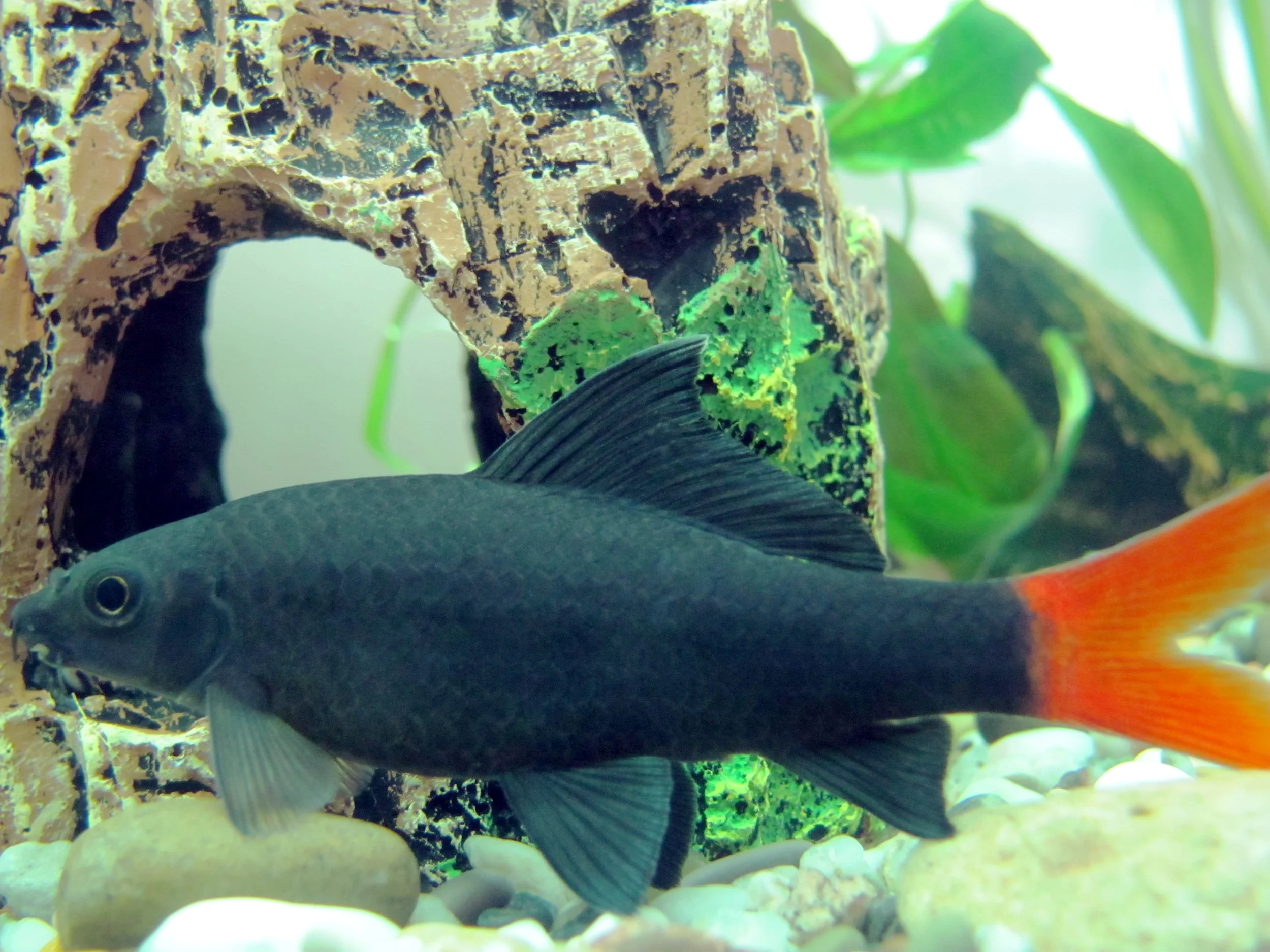
Epalzeorhynchos bicolor, commonly known as the Red-Tailed Black Shark, is a freshwater fish endemic to Thailand and critically endangered in the wild. Despite its name, it’s more closely related to carp than true sharks, and all aquarium specimens today are captive-bred. Fun Fact: That iconic red tail isn’t just for show — it can fade dramatically when the fish is stressed or sick, making it a living mood ring for water quality and tank harmony
Photo By Astellar87 - Own work, CC BY-SA 4.0, https://commons.wikimedia.org/w/index.php?curid=50817619
Description
Red Tail Sharks are showstoppers—jet-black from snout to dorsal, with a caudal fin abruptly colored in flame-red, sharp as a warning sign. Their torpedo-shaped body and upright dorsal fin evoke a “mini-shark” aesthetic for which they’re justly famous. Roaming the bottom and mid-levels, Red Tail Sharks move with the intent and curiosity of true predators, pausing to inspect rocks, stake territory, or scavenge food.
Bold, intelligent, and territorial, this species commands attention and space—one per tank is almost always best. Their assertiveness is matched by their resilience; when given a spacious environment, ample cover, and the right company, Red Tail Sharks reward the aquarist with lively behavior and dramatic visuals.
Adult Size:
4–6 inches (10–15 cm)
Recommended Tank Size:
55+ gallons (minimum for adults)
Experience Level:
Intermediate
Recommended Aquarium Parameters
Native to the clear, fast-moving rivers and lakes of central Thailand, Red-Tailed Black Sharks are striking, semi-aggressive bottom-dwellers that require space, structure, and pristine water conditions. Though often sold as juveniles for community tanks, they grow to 5–6 inches and become territorial as they mature. Long tanks (55+ gallons) are essential to provide swimming lanes and reduce conflict.
These fish thrive in well-oxygenated, filtered aquaria with moderate flow and stable temperatures between 72–79°F (22–26°C). Their preferred water chemistry is slightly acidic to neutral (pH 6.5–7.5) with moderate hardness (2–15 dGH). They are highly sensitive to ammonia and nitrite, and even moderate nitrate levels can trigger stress or illness — weekly partial water changes are non-negotiable.
A proper setup includes rockwork, driftwood, large-leaved plants, and shaded caves to mimic their natural habitat and allow territory marking. Stagnant water, overcrowding, or lack of cover will invite aggression and compromise health.
| Parameter | Range | Notes |
|---|---|---|
| Tank Size | 55+ gallons | Long tanks essential; reduces territorial behavior and provides swimming space |
| Temperature | 72–79°F (22–26°C) | Stable temperature range; avoid fluctuations |
| pH | 6.5–7.5 | Slightly acidic to neutral; consistent values preferred |
| Hardness (dGH) | 2–15 | Moderate hardness mimics native river conditions |
| Ammonia/Nitrite | 0 ppm | Highly sensitive; pristine water quality is critical |
| Nitrate | < 30 ppm | Weekly water changes required to maintain low levels |
| Flow | Moderate | Supports oxygenation and mimics fast-moving native habitat |
Compatible Tank Mates
Red-Tailed Black Sharks are semi-aggressive, territorial fish that thrive in spacious, well-structured tanks with carefully chosen companions. While visually stunning and hardy, they can become hostile toward similarly shaped or colored fish, especially those occupying the same bottom zones.
Ideal tank mates include robust, fast-moving mid- and upper-level species that don’t resemble the shark’s body shape or compete for territory. These include peaceful gouramis (Honey, Pearl, Dwarf), larger danios, rainbowfish, barbs, and tetras with confident schooling behavior.
Caution is required when housing more than one Red Tail Shark — they are highly territorial toward conspecifics and similar species like Rainbow Sharks. Only consider multiples in tanks over 125 gallons with abundant sightline breaks and defined territories.
Avoid pairing with slow, shy, or bottom-dwelling species such as small cichlids, nano fish, or shrimp. These are likely to be chased, stressed, or injured. Always prioritize tank layout that includes caves, driftwood, and visual barriers to reduce aggression and allow peaceful cohabitation.
| Category | Examples | Notes |
|---|---|---|
| Ideal | Honey Gourami, Pearl Gourami, Dwarf Gourami, Rainbowfish, Barbs, Larger Tetras, Larger Danios | Mid-/upper-level swimmers; fast, confident, and visually distinct from the shark |
| Caution | Other Red Tail Sharks, Rainbow Sharks | Highly territorial toward similar species; only one per tank unless in very large systems |
| Avoid | Small cichlids, nano fish, shrimp, bottom-dwellers | Risk of stress, chasing, or injury; poor compatibility due to space and behavior overlap |
| Tank Layout Tip | Driftwood, caves, large plants, rockwork | Breaks sightlines and defines territories; reduces aggression and supports peaceful cohabitation |
History and Origin
Once widespread across central Thailand’s lowland rivers, swamps, and floodplain canals — especially around Bueng Boraphet and the Chao Phraya basin — the Red-Tailed Black Shark was first described in 1931 by ichthyologist Hugh M. Smith. Early records noted its presence in Bangkok’s Silom canal and surrounding tributaries, where it was “not uncommon” in the 1930s.
However, by the mid-1990s, the species was believed to be extinct in the wild. Its decline was driven not just by over-collection for the aquarium trade, but more significantly by dam construction, deforestation, agricultural runoff, and the draining of native wetlands — all of which disrupted spawning grounds and degraded water quality.
In 2011, a small remnant population was rediscovered in a single location within the Chao Phraya basin, prompting its classification as Critically Endangered by the IUCN Red List. Today, Epalzeorhynchos bicolor survives almost exclusively through captive breeding programs, primarily in Southeast Asia and Florida. These operations maintain genetic lines and supply the global aquarium trade, but do not currently support reintroduction efforts.
Despite its rarity in nature, the Red Tail Shark remains common in aquaria, prized for its sleek black body, vibrant red tail, and shark-like swimming posture. Its popularity has helped raise awareness of freshwater conservation — but also underscores the disconnect between pet trade availability and wild status.
Temperament and Personality
Red-Tailed Black Sharks are best described as active semi-aggressors — bold, territorial, and constantly on patrol. They establish a “zone” within the tank, often centered around a cave, driftwood arch, or shaded crevice, and will vigorously defend it from perceived intruders. This behavior isn’t random; it’s instinctual, rooted in their wild ancestry where competition for shelter and spawning sites was fierce.
They are not true bottom-dwellers, but rather hover just above the substrate, darting through mid-level zones and inspecting every corner. Their movements are sleek and deliberate, often resembling a sentry on duty. When housed properly — with ample space, defined territories, and compatible tank mates — they coexist peacefully with mid- and upper-level swimmers.
However, aggression spikes when:
The tank is too small or lacks structure
Sightlines are open and unbroken
Tank mates resemble the shark’s shape or coloration
Multiple territorial species compete for the same zone
Red Tail Sharks are solo specialists — only one per tank is recommended unless housed in a very large system (125+ gallons) with abundant visual barriers. They may tolerate fast-moving companions that don’t challenge their space, but slow or submissive fish often become targets of chasing or stress.
Their personality is best supported by:
Defined zones using rockwork, driftwood, and plants
Moderate flow to mimic riverine movement
Tank mates that occupy different vertical zones
Consistent feeding routines to reduce competition
When these needs are met, Red Tail Sharks become dynamic, visually striking additions to the aquarium — confident, curious, and full of character.
Other Pertinent Care Information
Diet: True omnivores — readily accept sinking pellets, veggie wafers, algae, and frozen foods like bloodworms and brine shrimp. Occasional blanched vegetables (zucchini, cucumber) support digestion and enrichment. A varied diet helps maintain vibrant coloration and long-term health.
Tank Setup: Requires sand or fine gravel substrate, structured rockwork, shaded caves, and large-leaved plants to define territories. Moderate water movement and robust filtration are essential for oxygenation. Secure lids are a must — Red Tail Sharks are known jumpers, especially when startled or stressed.
Breeding: Practically impossible in home aquaria. Commercial breeding is conducted in controlled facilities using hormone induction. No known cases of natural spawning in standard tank setups.
Health Concerns: Highly sensitive to poor water quality. Susceptible to ich, stress-induced fungal outbreaks, and opportunistic bacterial infections when ammonia/nitrite levels rise or husbandry lapses. Aggression-related injuries may also lead to secondary infections.
Lifespan: Typically 5–8 years; can exceed 10 with optimal care, stable water conditions, and low-stress environments. Long-term success depends on tank size, layout, and compatible tank mat