Scarlet Badis
Common Name
Scarlet Badis, Gem Badis
Scientific Name
Dario dario
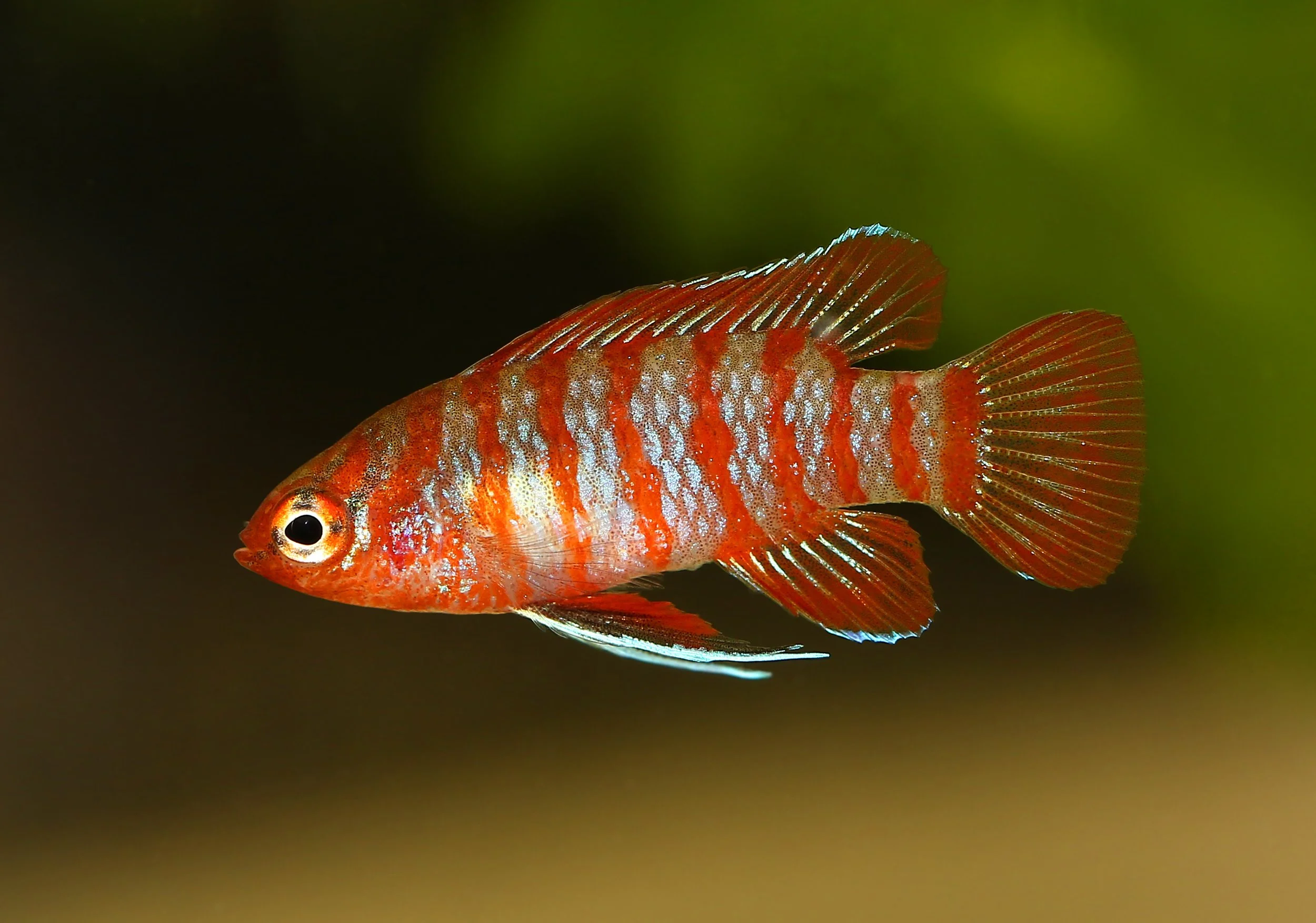
This close-up photograph captures a male Scarlet Badis (Dario dario) in full display. Scarlet Badis belong to the family Badidae and are micro predators, feeding on tiny invertebrates. Their small size and specialized diet make them sensitive to competition and ideal candidates for species-only nano setups. Fun Fact: Despite their bold colors and feisty displays, Scarlet Badis are among the smallest aquarium fish—males rarely exceed 1 inch (2.5 cm), making them true jewels of the freshwater nano world.
Adult Size:
0.75–1 inch (2–2.5 cm)
Recommended Group Size:
1 male with multiple females
Experience Level:
Intermediate
Recommended Aquarium Size and Water Parameters
The Scarlet Badis is a nano-sized micropredator native to slow-moving, plant-choked streams in West Bengal and Assam, India, particularly within the Brahmaputra drainage. Despite their small adult size of 0.8–1 inch (2–2.5 cm), they require thoughtful tank design and stable water chemistry to thrive.
Minimum Tank Size: A 10-gallon (38-liter) tank is suitable for one male and 2–3 females, provided there’s dense planting and visual separation. Males are highly territorial and may harass each other in confined spaces. For multiple males, a 20-gallon long or larger is recommended.
Temperature: Ideal range is 72–79°F (22–26°C). They tolerate brief dips to 70°F but are sensitive to prolonged heat above 80°F. Cooler water helps reduce aggression and supports oxygenation.
pH: Stable between 6.5–7.5, with a slight preference for neutral to slightly acidic conditions. Avoid sudden shifts, as Scarlet Badis are sensitive to instability.
Hardness: Prefer soft to moderately hard water, ideally 10–20 dGH. Wild populations are often found in soft, mineral-poor environments, but captive-bred specimens tolerate a wider range.
Flow & Filtration: Gentle flow is essential. Use sponge filters or low-output HOB filters with pre-filters to avoid stressing these delicate fish. Leaf litter, moss, and driftwood help replicate their natural habitat and buffer water chemistry.
Oxygenation: Moderate aeration is beneficial, especially in warmer setups. These fish are not adapted to high-flow environments like hillstream loaches, but they do appreciate clean, well-oxygenated water.
| Parameter | Range |
|---|---|
| Minimum Tank Size | 10 gallons (38 liters) for 1 male + 2–3 females |
| Temperature | 72–79°F (22–26°C) |
| pH | 6.5–7.5 |
| Hardness | 10–20 dGH (soft to medium) |
| Flow | Gentle; sponge or low-output HOB filter |
| Oxygenation | Moderate; clean, well-aerated water |
Compatible Tank Mates
Scarlet Badis (Dario dario) are shy, slow-feeding micropredators that thrive in calm, densely planted aquariums. Their timid nature and reluctance to compete for food make them poor candidates for typical community tanks. Species-only setups are ideal, especially when breeding is a goal or when showcasing their vibrant coloration and natural behavior.
However, in well-planted nano tanks, they can coexist with a select few species that meet the following criteria:
Peaceful temperament
Similar water parameters
Non-aggressive feeding habits
Occupy different zones of the tank
Best tank mates include:
Pygmy Corydoras (Corydoras pygmaeus): Bottom-dwelling, peaceful scavengers that won’t compete for live food.
Otocinclus Catfish: Gentle algae grazers that stick to surfaces and avoid confrontation.
Chili Rasboras (Boraras brigittae): Tiny, mid-water schooling fish that add movement without stress.
Adult Neocaridina or Caridina Shrimp: Safe with adults, but Scarlet Badis may prey on shrimplets.
Avoid any species that are:
Fast swimmers or aggressive feeders (e.g., guppies, danios)
Larger or boisterous (e.g., gouramis, barbs)
Bottom dwellers that compete for territory (e.g., plecos, larger loaches)
Important note: Males are territorial even with conspecifics. If housing multiple males, ensure dense planting and visual barriers to reduce aggression.
| Species | Compatibility & Notes |
|---|---|
| Pygmy Corydoras | Peaceful bottom dwellers; won’t compete for food |
| Otocinclus Catfish | Gentle algae grazers; avoid direct interaction |
| Chili Rasboras | Tiny mid-water fish; add movement without stress |
| Adult Shrimp (Neocaridina/Caridina) | Safe with adults; shrimplets may be eaten |
| Other Scarlet Badis | Territorial males need dense planting and space |
History / Origin
The Scarlet Badis, scientifically known as Dario dario, is endemic to the Brahmaputra River drainage in West Bengal and Assam, India, with possible populations extending into Bhutan. It inhabits shallow, clear-water streams with sand or gravel substrates, dense aquatic vegetation, and abundant leaf litter—conditions that foster a rich supply of microcrustaceans, insect larvae, and zooplankton. These environments shaped the Scarlet Badis into a highly specialized micropredator, relying on stealth and precision to hunt tiny prey.
Originally described in 1822 by Francis Hamilton as Labrus dario, the species has undergone several taxonomic revisions, eventually placed in the genus Dario within the family Badidae, which includes other small, cryptic fish adapted to similar habitats. The name “Dario” is derived from its Bengali name “Darhi,” reflecting its regional roots.
In the wild, Scarlet Badis are often found alongside other Badidae species such as Badis blosyrus and Badis kanabos, sharing the same microhabitats but occupying slightly different ecological niches.
Though once obscure in the aquarium trade, Dario dario has gained rapid popularity among nano aquarists and biotope enthusiasts thanks to its vibrant coloration, compact size, and complex social behavior. Males display striking red and blue vertical bands and elaborate fin extensions, while females remain more cryptic and subdued. Their small size and sensitivity to water quality make them a favorite among experienced hobbyists seeking to replicate authentic microhabitats.
Today, most Scarlet Badis available in the trade are captive bred, reducing pressure on wild populations and improving adaptability to aquarium conditions. However, their specialized diet and territorial nature still require careful planning, making them a rewarding challenge for aquarists who value authenticity and behavioral nuance.
Temperament and Personality
The Scarlet Badis (Dario dario) is a classic example of a nano fish with a big personality. Males are highly territorial, often staking out a favorite rock, leaf cluster, or shaded nook and defending it with flared fins and short bursts of chasing. In tanks under 10 gallons, it’s best to keep only one male, as multiple males will engage in frequent displays and may injure each other if space and cover are insufficient.
Despite their bold coloration and territorial instincts, Scarlet Badis are peaceful toward other species, especially those that don’t compete for food or occupy the same zone. However, they are slow, deliberate feeders, and easily outcompeted by faster fish—even those considered “peaceful.” In mixed-species tanks, they may retreat and become visibly reclusive, hiding among plants or leaf litter and missing meals.
Females are more cryptic and less aggressive, often remaining in the background unless actively courted. In well-planted tanks with stable water and low competition, Scarlet Badis males will display vibrant colors and engage in elaborate fin-flaring and “dance-like” territorial displays, especially during feeding or courtship.
They are most active during daylight hours and appreciate dim lighting with shaded zones, which mimic their natural forest stream habitat. Their behavior is best observed in species-only setups or carefully curated nano communities with ultra-peaceful tank mates.
Other Pertinent Information
Diet & Feeding: Obligate micropredators that refuse dry food. Thrive on live or frozen fare such as baby brine shrimp, daphnia, grindal worms, microworms, and blackworms. Target feeding is essential, especially in community tanks where they’re easily outcompeted.
Tank Maturity & Microfauna: Require mature, well-established tanks with a healthy population of microfauna (copepods, detritus worms, infusoria) to support natural foraging behavior and supplement nutrition between feedings.
Aquascaping Needs: Dense planting, leaf litter, mosses, and driftwood are essential for territory formation, visual barriers, and spawning sites. Floating plants help diffuse light and reduce stress.
Water Quality Sensitivity: Extremely sensitive to ammonia, nitrite, and nitrate spikes. Require stable, pristine water conditions with minimal fluctuations. Weekly water changes and gentle filtration are critical.
Breeding Behavior: Readily breeds in captivity under the right conditions. Males perform elaborate displays to court females, often in secluded plant thickets or small caves. Males guard the eggs post-spawning but may predate fry once they hatch. For best survival rates, remove adults after hatching.
Fry Care: Fry are tiny and require infusoria, vinegar eels, or green water as first foods. Transition to microworms and baby brine shrimp as they grow. A mature tank with biofilm and microfauna improves early survival.
Social Dynamics: Best kept as one male per tank under 10 gallons. In larger tanks, multiple males can coexist if heavily planted with clear territory boundaries. Females are less aggressive and more cryptic.
Common Health Issues: Prone to starvation if not target-fed. Susceptible to Ich, velvet, and bacterial infections in tanks with poor hygiene or unstable parameters. Avoid copper-based medications due to sensitivity.
Lighting & Activity: Prefer dim to moderate lighting with shaded zones. Most active during feeding times and early morning. Males display more frequently under stable, low-stress conditions.
Lifespan: Typically 3–5 years with proper care, though stress and poor diet can shorten lifespan significantly.